Anti-War Indoctrination encounters obstacles at Allis
The Wisconsin State Journal reports that "A letter-writing campaign by third-graders at Allis Elementary School encouraging an end to the war in Iraq was canceled."
"Madison School Board policy prohibits teachers 'from exploiting the institutional privileges of their professional positions to promote candidates or parties and activities.' [...] 'We don't want our staff ever using our students in a political activity, which this obviously was,'"
"Susan Abplanalp, assistant superintendent for elementary and secondary schools, said she does not believe the teachers involved viewed the assignment as a political activity."
Of course this impeaches the teachers' good sense and understanding. Not only are these people idealogues, willing to indoctrinate children, but they don't even realize that its objectionable.
Julie Fitzpatrick said, "We're really stunned by the reception. In hindsight, I guess we should have anticipated it. It's kind of sad when peace causes a furor."
This kind of statement is so idiotic, a mandatory review of her credentials to be in a classroom seems to be in order. Fitzpatrick just put herself on record opposing American independence, the Civil War and its natural consequence of freeing the slaves, the Second World War to end Fascism and its natural consequence of ending the Holocaust. Instead she stands in favor of the Nevillian quest for Peace in Our Time, or as it is also called, appeasment. Today, that includes some terribly illiberal forces.
One must think of the Niemöller quote in this context, about how foolish it is to watch one group after another capitulate to evil because you did nothing to aid them. Or likewise, Edmund Burke's, "All that is required for evil to triumph is for good men to do nothing."
When one's opponants are merely creatures of self-interest, it can be possible to oppose them with arguments to their interest, or with actions short of violence which aim at their interest, but some opponants are motivated by ideology, not interest. Such opponants will martyr themselves to achieve their goals, either because they think that some diety will use their deaths or because without their victory life is simply not worth living. In such cases, talk, diplomacy, sanctions, and scrunched up faces only serve to give the enemies of freedom more time to hit you in the head with a large hammer.
Teaching kids to look the otherway in the face of injustice and evil. Nice work. Instead, lets apply pressure to those who might do good, albeit imperfectly, and who, being concerned with justice and legitimacy are succeptable to reason and argument. So the evil ones being unpersuadable, let us therefore persuade the flawed forces of good not to confront those who gas their own people, pay bounties to terrorists, train and supply terrorists, plan and attempt assasinations of politicians out of office just for personal spite or to intimidate free peoples, and pursue weapons of mass destruction. Let's not bother them. Good job educators.
This problem isn't limited to foriegn policy, as Kimberly Swygert observes (regularly, click Zero Tolerance). What do principals recommend when their charges are attacked by bullies or other aggressors? "He should curl up on the ground in a ball and hope someone else runs to get help." I wonder who is supposed to play the role of the mean American and intervene? Probabaly someone with much more power and authority than the participants themselves. Sounds like Imperialism to me.
Saturday, December 03, 2005
VDH on the Iraqi Debate
"The moral onus should have always been on the critics of the war. They should have been forced to explain why it was wrong to remove a fascist mass murderer, why it was wrong to stay rather than letting the country sink into Lebanon-like chaos, and why it was wrong not to abandon brave women, Kurds, and Shia who only wished for the chance of freedom."
I certainly would be happier with an administration more capable of getting this message out there, but I have to observations to make on this subject.
One, as I have argued in previous posts, they really are, it just doesn't get out. Just a few days ago I made mention of the Pentagon podcasts and the Pentagon Channel. Rumsfeld speaks all the time, and he's clear and direct. But his arguments are not being covered in the MSM. Condi Rice gets out there and makes arguments. I hear the President. If you know where to look, its all there. The MSM is elsewhere, however. Who is to blame? The Administration for not breaking through, or the MSM for its hear no evil approach?
Second, Mark Steyn has observed that he can identify with the notion that there is nothing more to say, either you get it or you don't. So while I would like to see this argument a bit more front and center in the national dialogue, I wonder if it would have any effect.
"The moral onus should have always been on the critics of the war. They should have been forced to explain why it was wrong to remove a fascist mass murderer, why it was wrong to stay rather than letting the country sink into Lebanon-like chaos, and why it was wrong not to abandon brave women, Kurds, and Shia who only wished for the chance of freedom."
I certainly would be happier with an administration more capable of getting this message out there, but I have to observations to make on this subject.
One, as I have argued in previous posts, they really are, it just doesn't get out. Just a few days ago I made mention of the Pentagon podcasts and the Pentagon Channel. Rumsfeld speaks all the time, and he's clear and direct. But his arguments are not being covered in the MSM. Condi Rice gets out there and makes arguments. I hear the President. If you know where to look, its all there. The MSM is elsewhere, however. Who is to blame? The Administration for not breaking through, or the MSM for its hear no evil approach?
Second, Mark Steyn has observed that he can identify with the notion that there is nothing more to say, either you get it or you don't. So while I would like to see this argument a bit more front and center in the national dialogue, I wonder if it would have any effect.
Hitchens on Iraq
Some good recent Hitchen's posts on Slate. On Ramsey Clark:
"I meanwhile shall recline, happy in the knowledge that Saddam Hussein has engaged the services of an attorney who proclaims him to be guilty as charged."
On the double standard which takes no notice of Afghanistan, but wrings its hands over Iraq.
It links to this nifty cartoon in which maleavolent vipers labled Syria and Iran hover, detered by a powerful American eagle, while a little Iraqi baby eagle says, "I need to know your timetable for withdrawl." Indeed anyone in his situation would like to know when it would be that they would be abandon to the vipers.
On the nature of the debate over Iraq and the consequences of an early withdrawal.
Some good recent Hitchen's posts on Slate. On Ramsey Clark:
"I meanwhile shall recline, happy in the knowledge that Saddam Hussein has engaged the services of an attorney who proclaims him to be guilty as charged."
On the double standard which takes no notice of Afghanistan, but wrings its hands over Iraq.
It links to this nifty cartoon in which maleavolent vipers labled Syria and Iran hover, detered by a powerful American eagle, while a little Iraqi baby eagle says, "I need to know your timetable for withdrawl." Indeed anyone in his situation would like to know when it would be that they would be abandon to the vipers.
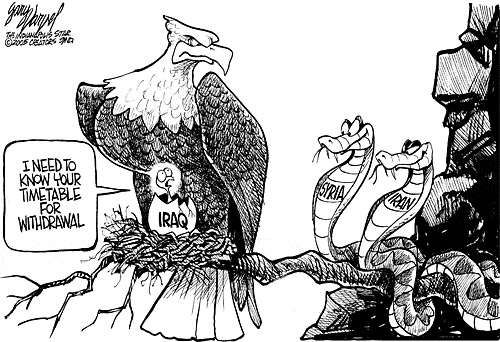
On the nature of the debate over Iraq and the consequences of an early withdrawal.
Belgian Woman: Suicide Bomber
Another Western seeker has been found on the other side. Muriel Degauque, the so-called "Belgian Kamakazi."
Another Western seeker has been found on the other side. Muriel Degauque, the so-called "Belgian Kamakazi."
Monday, November 28, 2005
Springfield Mill to Become Home of Nanotechnology Innovation
The 76 year old MFA building will become home to research and development companies, says News-Leader.
The 76 year old MFA building will become home to research and development companies, says News-Leader.
The Myth of the Scandinavian Model
In July, I posted about Sweden's shift from Socialism to Liberalism citing the downloadable book, Sweden after the Swedish Model. More recently, the Brussels Journal has compared the Scandinavian economies with others, in particular, Ireland. Charts a-plenty demonstrate the Liberal (liberty seeking) notion that low taxes stimulate growth while high taxes combines with generous welfare benefits result in stagnation and decline. Further, Ireland's tax structure puts relativly more emphasis on taxing consumption, rather than the more usual suspects of labor or capital.
In July, I posted about Sweden's shift from Socialism to Liberalism citing the downloadable book, Sweden after the Swedish Model. More recently, the Brussels Journal has compared the Scandinavian economies with others, in particular, Ireland. Charts a-plenty demonstrate the Liberal (liberty seeking) notion that low taxes stimulate growth while high taxes combines with generous welfare benefits result in stagnation and decline. Further, Ireland's tax structure puts relativly more emphasis on taxing consumption, rather than the more usual suspects of labor or capital.
Pentagon Podcasts
The Pentagon is bypassing the MSM with its own internet streaming and podcasting. Streaming can be found at pentagonchannel.feedrom.com and podcasting links are found here.
The Pentagon is bypassing the MSM with its own internet streaming and podcasting. Streaming can be found at pentagonchannel.feedrom.com and podcasting links are found here.
Sunday, November 27, 2005
Reverse Vietnam
Instapundit has a good post on Iraq and Vietnam. With the situation in Iraq, I have taken a longer and harder look at Vietnam, including reading Jim Dunnigan's Dirty Secrets of the Vietnam War and Max Boot's Savage Wars of Peace. My own thinking is reflected by the Tom Plank e-mail to Reynolds, "I am deeply skeptical of the claim that the military misled the press or the American people about the Vietnam War. [...] I thought the reporting on the war was nevertheless much more negative than what was actually going on."
One of the things that certainly different about Vietnam is that the military learned a lot of hard lessons about how to fight a large scale insurgency. This time around there is more nation-building, no attrition strategy, and no Johnson/Westmoreland happy talk. Apparently there is enough happy talk out there to give Jane Hall the notion that it should all be a ribbon cutting, but anyone who pays any attention at all hears analogy to the long twilight struggle of the Cold War, a long hard slog, and the like.
"The battle in Iraq and the battle in Afghanistan; it will be a slog, a long, hard slog. ...We're finding these terrorists where they are, and we're rooting them out, and we're capturing them, we're killing them. It's difficult work. It won't be over any time soon. And I will close by saying it will be a long hard slog, indeed."
Instapundit has a good post on Iraq and Vietnam. With the situation in Iraq, I have taken a longer and harder look at Vietnam, including reading Jim Dunnigan's Dirty Secrets of the Vietnam War and Max Boot's Savage Wars of Peace. My own thinking is reflected by the Tom Plank e-mail to Reynolds, "I am deeply skeptical of the claim that the military misled the press or the American people about the Vietnam War. [...] I thought the reporting on the war was nevertheless much more negative than what was actually going on."
One of the things that certainly different about Vietnam is that the military learned a lot of hard lessons about how to fight a large scale insurgency. This time around there is more nation-building, no attrition strategy, and no Johnson/Westmoreland happy talk. Apparently there is enough happy talk out there to give Jane Hall the notion that it should all be a ribbon cutting, but anyone who pays any attention at all hears analogy to the long twilight struggle of the Cold War, a long hard slog, and the like.
"The battle in Iraq and the battle in Afghanistan; it will be a slog, a long, hard slog. ...We're finding these terrorists where they are, and we're rooting them out, and we're capturing them, we're killing them. It's difficult work. It won't be over any time soon. And I will close by saying it will be a long hard slog, indeed."
Not as New as Some Think
Newsweek (via MSNBC's web site) thinks pod-casting lectures is new. Putting these things on televison, the campus public broadcasting channel, or the internet is not brand new. Podcasts are just the newest form of an older phenomena.
Newsweek (via MSNBC's web site) thinks pod-casting lectures is new. Putting these things on televison, the campus public broadcasting channel, or the internet is not brand new. Podcasts are just the newest form of an older phenomena.
A Ribbon Cutting?
Today on Fox News Watch, Jane Hall said that coverage of the Iraq War should be negative because the war isn't "a ribbon cutting."
Today on Fox News Watch, Jane Hall said that coverage of the Iraq War should be negative because the war isn't "a ribbon cutting."
Saturday, November 26, 2005
Insurgency
I don't get the claims that argue that Iraq isn't an insurgency. The Department of Defense (JP 1-02) defines "insurgency" as, "An organized movement aimed at the overthrow of a constituted government through use of subversion and armed conflict."
I don't get the claims that argue that Iraq isn't an insurgency. The Department of Defense (JP 1-02) defines "insurgency" as, "An organized movement aimed at the overthrow of a constituted government through use of subversion and armed conflict."
Good News on the New German Chancellor
Dawn's Early Light reports that in one tour through Europe, Angela Merkel, "has distanced herself from the non-democratic Russians, usurped the stumbling French, and opened the door to the outsider British while affirming America's role in European security."
Dawn's Early Light reports that in one tour through Europe, Angela Merkel, "has distanced herself from the non-democratic Russians, usurped the stumbling French, and opened the door to the outsider British while affirming America's role in European security."
Tuesday, November 22, 2005
Some Star Wars thoughts
Picked up Ep III and have watched all the extras (and the movie). I really miss the rebellion stuff with Mon Mothma, Bail Organa, and Padme Amadala plotting to stop Palpatine in the Senate. The stuff where the Jedi are doing this, seemingly by themselves, is far less satisfying than it would have been if the plots of this group had been in the film.
1) It makes the tragedy of Anankin's sticking with Palpatine even more painful to realize that Padme was organizing against the Sup-Chan.
2) As it is, the struggle seems to be between Palpatine and the Jedi for control and influence, but with the future rebels, its more like Palpatine against everyone he hasn't tricked and co-opted. The more broad-based and legitimate the resistance to Palpatine, the more Anakin has been seduced (the word Obi-Wan uses several times in Ep IV) rather than acted on legitimate grievances against the ambitious jedi.
3) It sets up another layer of connection and continuity with later films, where we heard about Bail Organa, see a little of Mon Mothma, and know about the rebellion.
My brother has posted on EP III recently. He's concerned about the curious style of acting involved. I make several points on that subject. 1) These people are largely artificial people. Like a lot of politicians, they have a fake front, and that false presence is visible. 2) Lucas doesn't want character to get in the way of his mythology. 3) Lucas' direction is as off-kilter as he is. Interviews with Lucas kind of reveal him to be stilted and wooden. Interviews with directors are often less smooth and silky than those with actors, but Lucas is particularly unnatural. I suspect he just put himself into those roles. 4) Palpatine and Obi-Wan were established characters. That might have created a bit of room for those actors to work. 5) Hayden Christenson is the Anthony Perkins of his generation. 6) Natalie Portman is a good actress, but couldn't get out from under Lucas' direction. Watching the extras, Lucas appears to think you show emotion by turning away from the camera.
This isn't an argument its a list of observations.
Picked up Ep III and have watched all the extras (and the movie). I really miss the rebellion stuff with Mon Mothma, Bail Organa, and Padme Amadala plotting to stop Palpatine in the Senate. The stuff where the Jedi are doing this, seemingly by themselves, is far less satisfying than it would have been if the plots of this group had been in the film.
1) It makes the tragedy of Anankin's sticking with Palpatine even more painful to realize that Padme was organizing against the Sup-Chan.
2) As it is, the struggle seems to be between Palpatine and the Jedi for control and influence, but with the future rebels, its more like Palpatine against everyone he hasn't tricked and co-opted. The more broad-based and legitimate the resistance to Palpatine, the more Anakin has been seduced (the word Obi-Wan uses several times in Ep IV) rather than acted on legitimate grievances against the ambitious jedi.
3) It sets up another layer of connection and continuity with later films, where we heard about Bail Organa, see a little of Mon Mothma, and know about the rebellion.
My brother has posted on EP III recently. He's concerned about the curious style of acting involved. I make several points on that subject. 1) These people are largely artificial people. Like a lot of politicians, they have a fake front, and that false presence is visible. 2) Lucas doesn't want character to get in the way of his mythology. 3) Lucas' direction is as off-kilter as he is. Interviews with Lucas kind of reveal him to be stilted and wooden. Interviews with directors are often less smooth and silky than those with actors, but Lucas is particularly unnatural. I suspect he just put himself into those roles. 4) Palpatine and Obi-Wan were established characters. That might have created a bit of room for those actors to work. 5) Hayden Christenson is the Anthony Perkins of his generation. 6) Natalie Portman is a good actress, but couldn't get out from under Lucas' direction. Watching the extras, Lucas appears to think you show emotion by turning away from the camera.
This isn't an argument its a list of observations.
Is Wobbliness New?
There is a sentiment out there ( I hear it a lot, most recently in Hugh Hewitt) that at one time Americans understood and supported their wars. I cite the large number of Tories during the Revolution, the consideration of succession in New England during the War of 1812, the serious Copperhead movement in the Civil War, the draft riots during same, the American Anti-Imperialism League, the WWI draft resisance movement, and only then do we get to Vietnam. American wars have been beset from the begining by large segments of people who didn't support the wars of their own generation. WWII is an exception in part because both the left and the liberals accepted the fight against fascism, and the right is generally willing to fight other rightists. And yet even then, we can point to the exceptional delay in getting involved in the war because of isolationism. From 1939 to 1941, Americans did not undertstand war or the neccesity of defense against a hostile ideology. Going Wobbly is as old as the Republic.
There is a sentiment out there ( I hear it a lot, most recently in Hugh Hewitt) that at one time Americans understood and supported their wars. I cite the large number of Tories during the Revolution, the consideration of succession in New England during the War of 1812, the serious Copperhead movement in the Civil War, the draft riots during same, the American Anti-Imperialism League, the WWI draft resisance movement, and only then do we get to Vietnam. American wars have been beset from the begining by large segments of people who didn't support the wars of their own generation. WWII is an exception in part because both the left and the liberals accepted the fight against fascism, and the right is generally willing to fight other rightists. And yet even then, we can point to the exceptional delay in getting involved in the war because of isolationism. From 1939 to 1941, Americans did not undertstand war or the neccesity of defense against a hostile ideology. Going Wobbly is as old as the Republic.
Tuesday, November 15, 2005
Wargames use in Analysis
There is a good piece up recently over at Strategy Page on the analytical use of wargames.
"What about the war on terror? From a wargamers perspective, it’s not a difficult conflict to simulate. [...] Same with the war in Iraq, or Afghanistan. Both countries are behaving as they have for centuries. Anyone familiar with the history of these two places, won’t be surprised with what’s going on there now, or how it’s all going to turn out. Forget the media, they haven’t a clue, and don’t need one to stay in business. Remember, wargamers are also historians. They look at things from a historical perspective, and immediately apply an OR approach to any even they are studying."
There is a good piece up recently over at Strategy Page on the analytical use of wargames.
"What about the war on terror? From a wargamers perspective, it’s not a difficult conflict to simulate. [...] Same with the war in Iraq, or Afghanistan. Both countries are behaving as they have for centuries. Anyone familiar with the history of these two places, won’t be surprised with what’s going on there now, or how it’s all going to turn out. Forget the media, they haven’t a clue, and don’t need one to stay in business. Remember, wargamers are also historians. They look at things from a historical perspective, and immediately apply an OR approach to any even they are studying."
Podhoretz on the "Bush Lied" meme
John Podhoretz has a discussion of the "Bush Lied" meme in Commentary. It includes quotes from Democrats in 2002 that those same Dems try to dodge today.
John Podhoretz has a discussion of the "Bush Lied" meme in Commentary. It includes quotes from Democrats in 2002 that those same Dems try to dodge today.
Monday, November 14, 2005
Riots in France
Gina Cobb poses some interesting questions that have not been addressed much.
Gateway Pundit has a nice round-up with pics, locations, and a chart or two.
When Katrina hit, the c18-L list was very active with posts on what this reveals about America's dark under-belly. As of the last time I looked (maybe yesterday) there has been no comment on this, and its been going on for a long time.
Gina Cobb poses some interesting questions that have not been addressed much.
Gateway Pundit has a nice round-up with pics, locations, and a chart or two.
When Katrina hit, the c18-L list was very active with posts on what this reveals about America's dark under-belly. As of the last time I looked (maybe yesterday) there has been no comment on this, and its been going on for a long time.
Tuesday, November 08, 2005
From ancient grudge break to new mutiny, where civil blood makes civil hands unclean.
Such is the nature of revolution, that once begun, it is hard to end; at least for everyone. I have been witness to an office revolution that was originally caused by a spectacularly bad manager. Everyone had great discontents and these were generally known. What was missing was some action to set things over the edge. Of course this could be some 0utrage by the manager, but might also be the act of a praticed revolutionary. In this case, enter the revolutionary. A practiced hand at office politics, this individual had twice before conducted revolutionary actions in the workplace. Once to oust his boss and take her place, once with little effect on behalf of others more agrieved. This effort would be the third such effort. For some time he had been willing to follow the banner of another, but took no action on his own.
Enter another, more radical revolutionary. He proposed a more radical agenda with no widespread support.
Concerned that this more radical revolutionary might take the day, if only because he was the only one acting, our more experienced revolutionary decided to act to produce a more moderate revolution. Skilled with the various arts of politics, the moderate won the action of the whole office, and with some bumps, revolution was achieved. However, the radical got little if any of his agenda. Others advanced their agenda broadly, sometimes too hurridly, but the radical got nothing. So he continued to foment revolution, but as a radical cell disconnected from his peers, and indeed against his peers. Our moderate revolutionary now found himself in the role of a counter-revolutionary, like Washington putting down the Wiskey Rebellion.
Such is the nature of revolution, that once begun, it is hard to end; at least for everyone. I have been witness to an office revolution that was originally caused by a spectacularly bad manager. Everyone had great discontents and these were generally known. What was missing was some action to set things over the edge. Of course this could be some 0utrage by the manager, but might also be the act of a praticed revolutionary. In this case, enter the revolutionary. A practiced hand at office politics, this individual had twice before conducted revolutionary actions in the workplace. Once to oust his boss and take her place, once with little effect on behalf of others more agrieved. This effort would be the third such effort. For some time he had been willing to follow the banner of another, but took no action on his own.
Enter another, more radical revolutionary. He proposed a more radical agenda with no widespread support.
Concerned that this more radical revolutionary might take the day, if only because he was the only one acting, our more experienced revolutionary decided to act to produce a more moderate revolution. Skilled with the various arts of politics, the moderate won the action of the whole office, and with some bumps, revolution was achieved. However, the radical got little if any of his agenda. Others advanced their agenda broadly, sometimes too hurridly, but the radical got nothing. So he continued to foment revolution, but as a radical cell disconnected from his peers, and indeed against his peers. Our moderate revolutionary now found himself in the role of a counter-revolutionary, like Washington putting down the Wiskey Rebellion.
Saturday, November 05, 2005
Salafi Jihad
I've found Marc Sageman's Understanding Terror Networks to be very useful. Recently I've been reading Fawaz A. Gerges The Far Enemy. Its a vert good compliment to Sageman, since they cover the same material, but draw on different sources and vary a bit in their emphasis and interpretation. Sagemen asks, who are the terrorists, and after a history of the Salafi Jihad, considers their background, experiences, education, social class, and other factors which dispell myths about who the terrorists are. Gerges explains that among jihadists, the concern with the far enemy is unusual, and tries to explain why Al Qaeda made this move to internationalize jihad. Sageman discusses this, but not with the depth and sophistication of Gerges. Of course Sageman deals with some things better than Gerges as well.
I've found Marc Sageman's Understanding Terror Networks to be very useful. Recently I've been reading Fawaz A. Gerges The Far Enemy. Its a vert good compliment to Sageman, since they cover the same material, but draw on different sources and vary a bit in their emphasis and interpretation. Sagemen asks, who are the terrorists, and after a history of the Salafi Jihad, considers their background, experiences, education, social class, and other factors which dispell myths about who the terrorists are. Gerges explains that among jihadists, the concern with the far enemy is unusual, and tries to explain why Al Qaeda made this move to internationalize jihad. Sageman discusses this, but not with the depth and sophistication of Gerges. Of course Sageman deals with some things better than Gerges as well.
Subscribe to:
Posts (Atom)